


2025


On the first page, users can take their own time to sense the connection between text and sound, as the sounds are “frozen.” Playback follows the speed of the finger gesture and its position on the image.
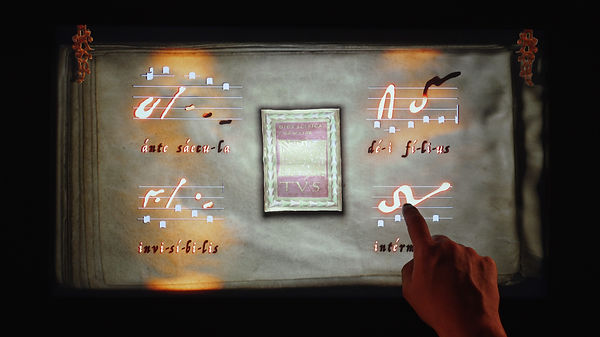
On the second page, time- and position-free notation fragments (adiastematic) are connected with more familiar forms of notation. The temporal progression is shown visually in real time as a loop (similar to karaoke).

On the third page, an original fragment can be heard in its temporal interpretation. Afterwards, individual text fragments can be manually compared: identical or similar melodic gestures can be played back across different text fragments and contrasted with one another. In addition, fragments can be combined in a self-defined sequence in real time.
With this playful exploration of a musical tradition that is temporally distant from us, I aim to open a space for reflection for children, young people, and adults, demonstrating that many different forms of notation were, are, and will be possible – depending on the musical material, the performance context, and the mode of transmission.
The installation was conceived and realized on behalf of and with the support of the Kindermuseum Bremen e. V. for the exhibition "Kapier Papier" at the Hafenmuseum Bremen (Sept 2025- Feb 2026)

Klangspuren hören
Listening to Sound Traces – A Short History of Paper Music
(from the explanation panel of the Kindermuseum)
For a long time, people all over the world have tried to record music using signs: for example, high and low, short and long, or loud and soft can be written down in many different ways. Even the movements required to play an instrument can be represented indirectly in this way.
However, this always required something on which the signs could be placed: in the past parchment or paper, today sometimes even screens. You are invited on a short journey through the history of paper – from the Middle Ages to the present day. And who knows: what might be invented in the future to help us share our musical ideas with one another?
In this installation, I connect sonic events with their graphic representation through haptic interaction. As a core material, I chose the following example: the sequence “Natus ante saecula” from the collection “Tropi carminum: Liber hymnorum”, written by Notker Balbulus (ca. 840–912 AD) in the year 884 AD.
My fascination lies in the fact that this type of notation and music contains a mysterious yet intuitive idea for representing sounds: neumes.
(Excerpts from Wikipedia)
[…] A neume is the basic graphic unit of Western European music notation before the invention of staff notation (five-line staff). […]
[…] These are signs or figures written above the text of a chant (e.g. Gregorian chant) that indicate melodic contour and phrasing, but not necessarily exact pitch or rhythm. […]
[…] Whether neumes were intended to depict or stylize actual finger and hand movements (“gestures”) of the cantor cannot be determined from historical sources. […]
[…] Originally, neumes served as mnemonic aids to recall already familiar melodic formulas of orally transmitted liturgy. […]
Here, I use a touch-sensitive monitor as a digital book in which visitors can touch excerpts from the original manuscripts and trigger the corresponding sounds associated with the letters and graphic signs.
There are three different ways of interacting with the material, distributed across virtual book pages.